Wednesday, December 9, 2015

NoirDragon - Asian Inspired Teaware on Etsy

For most of my tea reviews I use a white teacup, or sometimes clear glass.  If I'm drinking tea alone I use one of my cups that are the same volume as my brewing vessels so I can just pour my brews directly into the cup without using a cha hai.  A white teacup is perfect for showing the color of the tea liquor, and if you don't use a strainer and get some small leaf pieces in the cup you can easily judge the clarity of the liquor.

However, none of these white cups are my favorite teacup.  My favorite teacup doesn't end up in photos very often because it's one I use when I'm simply drinking tea for myself, for pure enjoyment.  So I decided that my favorite cup itself deserves to be in the spotlight today.


This cup came from an American artist who sells teaware on his Etsy store "NoirDragon."  One interesting thing about NoirDragon is that his path to producing beautiful ceramic teaware is completely rooted in his passion for tea.  His passion for tea naturally lead him to appreciate and collect teaware, and then eventually he decided to learn more about the art of pottery so that he could create his own teaware.  And now he is sharing his creations with fellow tea lovers.

NoirDragon has used a beautiful stoneware clay for this cup and left a band of unglazed clay at the outer bottom edge to show off both the color and texture of this clay.

The quality of my NoirDragon cup shows very precise craftsmanship and attention to detail.  I can turn this cup over and set it on a flat surface and the rim is perfectly even and the base is perfectly level.  I discovered this by chance while trying to photograph the bottom of the cup and was very impressed with the geometric perfection.


I'm really happy with the glaze/color of this cup.  The inside has a slight blue hue to it, and the outside has a bit more green.  I used to say that I don't have a favorite color because all colors can be great depending on context, but despite that, I do admit that I tend to gravitate toward green, and I absolutely love the color of this cup.

At first I assumed that the speckled pattern on this cup was due to the glaze used, but when I asked the artist about it, NoirDragon told me that the speckles are actually due to manganese granules in the clay itself that produce this beautiful pattern through the glaze when fired in the kiln.  If white glaze is applied to this clay, it will show up as little brown speckles on the white glaze which also has an interesting effect.

This has easily become my favorite cup for more than just the appearance and craftsmanship as it functions very well for my typical personal tea brewing sessions.  True, it doesn't have a white interior so it doesn't show off the tea liquor, but adding a glass cha hai would take care of that if needed.  I really love this cup though because it is the perfect volume for holding the contents of an 80ml gaiwan.  The 80ml gaiwan is the brewing vessel I use about 85% of the time I brew tea, and I can pour directly into this cup and it fills it to the top.  The clay is thick enough to keep my hands from getting too hot, and once preheated, that thickness holds in heat well to keep the tea warm as I sip.  The size, shape, and weight of the cup feels perfect and natural in the hand.  Drinking from this cup allows me to have a better connection with the tea and I'm able to enjoy the tea without being distracted by an uncomfortable or awkward cup.


NoirDragon's creations are continually evolving, and I really look forward to seeing what he comes up with next.  Through recent conversations I have learned that he often tries out new glazes and clays.  He has some pieces that have a crackle glaze, and a few that have a really interesting highly textured "crawl glaze" that look like they were crafted directly from parched earth.  I have also heard that he is experimenting with brewing vessel designs such as shiboridashis and possibly gaiwans, and I think he may even be trying out some tea pet designs!

So you may not see this cup make an appearance too often in my tea reviews, but if you stop by when I'm having an enjoyable tea session with my favorite teas, there's a real good chance that I'll be sipping from my favorite teacup.


Link to NoirDragon on Etsy: https://www.etsy.com/shop/NoirDragon

Sunday, December 6, 2015

White2Tea - 2015 Pin (Raw Puerh)

When White2Tea first shared a teaser image of the mao cha they were using for an upcoming sheng cake, I was quite confused by the apparent nei fei in the image.  The nei fei (a small inner label pressed into a puerh cake) had a reddish blob that appeared to be a pair of lips. But knowing that this is White2Tea, which never fails to amaze me with their unique style and creativity, I decided that this was probably not an optical illusion, and it was best to just accepted the high probability that I actually was seeing a mouth and hope the meaning of that would be clear later on.

I later learned that this new cake is named Pin, and the outer wrapper has not one but three colored blobs that are, without a doubt now, mouths.  I'm sure anyone with a good understanding of Chinese probably got a chuckle out of this, but the rest of us need some explanation from TwoDog.

White2Tea - 2015 Pin sheng puerh 200g cake

According to TwoDog, the Chinese word for "mouth" is "kou" and represented by the chinese radical 口.  If you have three of these radicals in a triangle configuration, you get 品, the word "pin."  The word "pin" is Chinese for "to savor" and he further explains that it could be applied to a drink, such as tea, to mean, "drinking with intent." Further he explains that the phrase "pin cha" (品茶) "literally means 'to taste tea.'"  This wrapper has even deeper meaning than that though.  The triangle theme is also represented in the red/pink background which is actually a triangle when the wrapper is unfolded.  The three mouths or three points/sides/angles of the triangle represent the tea material used to make Pin, which is a blend of Lincang material from 2013, 2014, and 2015.

Aww, the nei fei got flipped over during pressing.
Blended Lincang material from 2013, 2014, and 2015. 

The 200g cake as a whole shows a beautiful mosaic of colors.  This is partially due to the fuzzy white buds mixed with the fuller leaves, but is also likely a result of the blended material of different ages.  The older material was stored by TwoDog in Menghai to mellow out a bit in contrast to the young 2015 material.  The compression is a good "medium" -- not so loose that it can be pulled apart by hand, but loose enough that a tea pick can separate it without doing too much damage.

White2Tea - 2015 Pin sheng puerh


I wasn't entirely sure the best way to brew this tea and I'm still experimenting, but so far I have been using water around 200 degrees F which I sometimes use for younger raw puerh.  Of course this one also has components from 2014 and 2013, so going with water right off a boil might not be too risky.  I have stuck with my usual 5g per 80ml gaiwan for now and started my first few infusions around three to five seconds or so.

White2Tea - 2015 Pin sheng puerh

Maybe it’s because I just got over a mild cold and can breathe better today than any day this past week, but the wet leaf aroma of this tea is very strong, and although it does have a “young raw puerh” aroma, it seems much deeper than some, likely due to the older material also used.  Imagine autumn leaves coated in dark honey-- that may sound strange, but an aroma like that in a tea is amazing.

The honey colored clear liquor is very viscous and has a thick mouthfeel-- it is one of those teas that you almost feel the need to chew while drinking it.  The sides of the tongue feel some mild astringency at first, and then a couple minutes later the entire mouth feels a subtle tingly sensation.  It's suiting that a tea with three mouths on the wrapper would have such an active mouthfeel.

The overall taste of Pin is very well balanced.  It has a general herb-like flavor similar to oregano accompanied by grassy and hay notes, and early on it also has a hint of clean smoke which seems to fade in the middle and late infusions.  After the first three or so infusions the flavors become even more balanced and stay very consistent with each subsequent infusion.  These middle infusions bring out a pleasant sweetness that contrasts well with the young sheng bitter bite.  This is again one of those teas where I lost count of how many infusions I got out of it, but my 1.7L electric kettle was giving me a "Low H2O" warning before I was finished.   Well balanced flavors and many consistent infusions seems to be a great indicator of high quality material.

Beautiful deep olive green leaf color.  I broke this selection from a tighter part of the cake but was still able to leave many leaves mostly intact.

Beyond the taste is a wonderful aftertaste which further indicates the high quality of material used to make Pin.  The aftertaste first retains the hint of smoke and herbal characteristics found earlier, but then blossoms into a nice tea perfume hui gan that lingers in the mouth for several minutes.  I should also mention that the cha qi from this tea was quite noticeable when I drank it.  This is certainly a great tea to drink with intent and savor, and I'm very curious to see how this one will taste many years down the road.  


Pin was released in November to celebrate the one-year anniversary of the White2Tea monthly tea club, but is also for sale in the White2Tea 2015 raw puerh lineup; sample sizes also available.  More details can be found here: http://www.white2tea.com/tea-shop/2015-pin/

Sunday, November 1, 2015

Taiwan Tea Crafts - Red Jade Black

I recently did a tea trade with fellow tea drinker and received a generous 25g packet of Red Jade black tea sold by Taiwan Tea Crafts.  My friend also sent a 25g packet of Taiwan Tea Craft's GABA oolong, but I am trying the Red Jade first.  I have never actually ordered any teas from this vendor, but am thankful for the opportunity to give a couple of their teas a try.

This particular packet of Red Jade that I have is lot #346 and is the 2014 version of the current 2015 Sun Moon Lake Red Jade, which is a TRES #18 style black tea.  As I briefly mentioned in my Formosa Assam entry in August, Taiwan's Tea Research Extension Station (TRES) in the Sun Moon Lake/Yuchi area of Nantou County has done extensive research to develop various Camellia sinensis tea hybrids, and TRES #18 is one of the most popular Taiwanese black teas.  The 2014 and the 2015 versions of this tea are from the the same farmer/producer, and the foil package contained an oxygen scavenger packet which has likely helped keep this tea extremely fresh.


This offering from Taiwan Tea Crafts is a near perfect Taiwanese black tea.  The dry leaf is very fragrant with a nice fruity aroma and the leaves are very long and mostly whole.  The wet leaf has a yummy fruity sweet candy-like aroma which also comes across in the flavor.  Like my other favorite Taiwanese black tea, this one has lots of berry flavors and a nice creaminess to it.  The sweet berry flavors are held up by a solid foundation that I simply call "black tea" flavor-- it's the part of the flavor that gives the tea some boldness.  The mouthfeel is also very bold, thick, yet soft, and a hint of astringency.  Like many good teas, Red Jade provides a strong pleasant aftertaste similar to the main taste, and the leave have wonderful resteepability.  I used 5g in a 120ml gaiwan and almost ran my 1.7L kettle dry while brewing this tea today.  I imagine the leaves could have gone even further.


Again, I have not tried any other teas from Taiwan Tea Crafts yet, but Red Jade was an excellent introduction for me.  (I will try the GABA oolong soon.)  If the quality of Red Jade is representative of their other teas, then I look forward to shopping with them quite a bit in the future to try more of their large selection of oolong and black teas!

Tuesday, October 20, 2015

Tea From Vietnam (.com)

On September 2nd, Tea From Vietnam had a Vietnamese Independence Day sale and offered their tea 20% off and a reduced free shipping threshold.  I decided to take advantage this great sale and I picked up three of their oolong teas: Golden Lily (Jin Xuan), Ta, and Gui Fei.  I also received a sample of their "Red Lily" which is a black tea made from Jin Xuan leaf.

While thinking of my new Vietnamese teas, I had a craving for some pho and thought this would make a perfect pairing.


Unfortunately though, I made my pho much too spicy which completely ruined my palate.  I cannot possibly enjoy tea right now so instead I will use this time to read Tea From Vietnam's blog and learn a little bit more about them.

Tien Vu launched Tea From Vietnam earlier this year and is proud to offer tea produced by his family in the northern province of Thai Nguyen, Vietnam.  Mr. Vu respects the history, reputation, and ideal terroir associated with Chinese, Taiwanese, and Japanese teas and does not try to claim that his teas will outdo the best of those traditional teas but instead promotes his teas as examples of some of the finest tea that Vietnam can offer to a tea lover wanting to experience tea from other regions.  Although Taiwanese style teas have been grown in Vietnam only in recent years, Mr Vu has provided an in depth review of the history of tea from the Vietnamese perspective which shows how deep the tea roots really are in Vietnam and the importance of the Thai Nguyen province for high quality tea production.


Of the teas I have in my order, the Golden Lily and the Ta oolongs both fall in the "jade" (low roast/low oxidization) oolong category.  The Golden Lily, as expected, is made from the Jin Xuan cultivar of leaf which was introduced to Vietnam from Taiwan a couple decades ago.  The Ta oolong though is a cultivar that is unique to Vietnam and is why I wanted to give it a try.


These two teas may seem pretty similar at fist.  The oxidation level is about the same and they both brew up a nice looking very clear light yellow liquor.  Both teas have the distinct "gao shan" aroma that you would expect from this style of oolong, and since these teas were grown at or slightly higher than 1,000m elevation, they may qualify as "high mountain" oolongs if defining that term by elevation alone.  The aroma does present slightly differently for each of these teas though.  Both teas smell of sweet honey and buttery toffee, but the Golden Lily is more vegetal and reminds me of tomatoes where as the Ta leaves are more floral with a slight nutty/cashew aroma.

The mouthfeel of the Golden Lily is surprisingly active with some pleasant atringency, though not much body, and the Ta oolong is very smooth and coats the mouth.

Golden Lily, also known as Jin Xuan is sometimes marketed as "milk oolong" due to a natural milk-like flavor that it can sometimes have.  The Vietnamese Jin Xuan definitely has a very creamy taste.  I even let my 5 year old daughter have a sip and she herself said that it tasted a bit "like milk and something else."  The "something else" in my opinion is the vegetal almost green tea-like flavors resulting from the low oxidization.  The green tea-like flavor also has a nutty characteristic to it like you might find in Dragonwell or some other green teas.  Although the vegetal flavor does dominate at first, there is a good floral aspect as well and later steeps reveal a pleasant lychee flavor.  (To avoid confusion, I should mention that this "milky" flavor is definitely a natural flavor in the tea and should not be confused with artificially flavored milk oolongs sold elsewhere.  TeaFromVietnam doesn't even mention this alternate name of Jin Xuan, but it's just a flavor note I picked up on.)

The Golden Lily aftertaste is slightly peppery early on, but then later becomes more floral.  Of the few times I have brewed this tea now, I find that it does best with slightly more leaf than I originally thought I would need.  Not much more, but an extra one half to one gram seemed to really help this tea deliver a fuller flavor and not taper off as quickly.  As the tea does taper off though, long infusions can produce a good vegetal tea soup that still provides an interesting floral aftertaste.
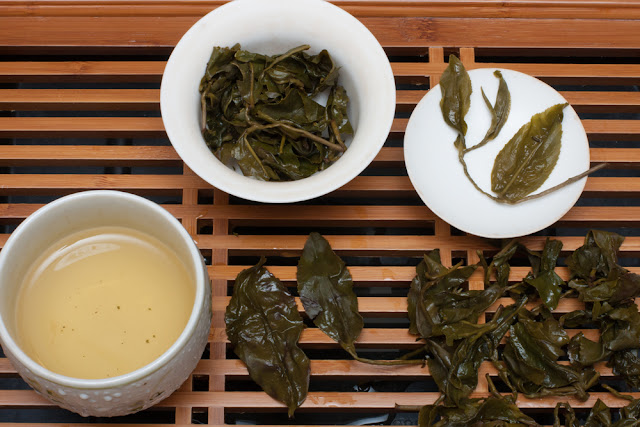
Tea From Vietnam - Golden Lily oolong - Great looking leaves!


The flavor of the Ta oolong is also very creamy, but it does not have the same dominating vegetal nature as the Golden Lily and instead has a nice citrus (orange, grapefruit) flavor with lemongrass and a nice floral perfume taste in the back of the throat.  Subsequent infusions reveal more light honey sweetness that combines with the creaminess to create a sugar cookie-like taste.  The enjoyable aftertaste is floral and lingering.  

Tea From Vietnam - Ta oolong - Also great looking leaves!
Another difference between Golden Lily and Ta is the price.  Golden Lily is $5.90 for 50g and Ta is $11.90 for 50g.  Part of the price difference is likely due to supply-- Jin Xuan cultivar is grown more commonly than Ta and is a high yield cultivar which can make it more affordable.  Of course personal preference will dictate if these are good deals, but I think the prices are good.  Although I am not personally a huge fan of the milky vegetal flavor of Golden Lily, I enjoy the tea enough that I think it's definitely worth $5.90 for 50g and I would be happy to buy this tea again as a daily drinker jade oolong.  I also think that the higher price for the Ta oolong is a good deal too because I prefer the flavor profile of the Ta much more-- it's a well balanced tea with good gao shan flavor and complexity. 


In contrast to the low oxidized Golden Lily, I also received a small sample of the Red Lily which is a black tea made from Jin Xuan leaf.  Red Lily is fully oxidized and has a medium bake/roast. Close examination of the leaf though does show some greenness.


Due to the rolled nature of this tea and large leaf size, it seems to do better with more leaf than I typically use for black tea-- a good leaf to water ratio would be similar to what I use for oolongs, roughly 5g per 80ml, though I would like to experiment more to see if any other parameters would have an effect on this tea.  The first time I brewed it I did not use enough leaf so I used more leaf the second time which helped.

The Red Lily brews up a beautiful clear orange liquor and the leaves unroll fairly quickly and give off an aroma of dark raisins, black cherries, dark chocolate and a hint of strawberry.  The first infusion had a darker version of that milky "jin xuan" taste which I did not enjoy, but the tea became much more enjoyable in the second and third infusions where it transformed into a nice peach cobbler with ice cream flavor, dark cherry, and cotton candy.  Later it reminded me of apple cider spices (cinnamon, nutmeg, etc), dried orange peel, and figs with a similar aftertaste having a brown sugar sweetness.  Occasionally though I would get a slight milky reminder that this is Jin Xuan which is not something I'm used to in black teas and that made it difficult for me to really enjoy this one as much as I did the oolongs.  At $6.90 per 50g though, it may be worth a try for something unique as it is the only black tea available right now from Tea From Vietnam, but I would like to see them offer some others in the future-- perhaps a Vietnamese version of an Assam would be really interesting.  

Tea From Vietnam - Red Lily - Really nice looking leave, some greenness to them despite being a black tea.


My final tea from Vietnam is the Gui Fei oolong.  This type of oolong is low roast but moderately oxidized and is similar to Oriental Beauty in that leafhopper insects are allowed to nibble on the leaves prior to harvest which causes the leaves to produce additional flavor compounds that add an extra layer of complexity and sweetness to the tea.


The Gui Fei ended up being my favorite tea that I tried from Vietnam.  The wet leaf is very fragrant of dark honey, nutmeg, raisin, a hint of chocolate, and the muscat grape that is common in Darjeelings and also leafhopper oolongs.  The liquor is an orange dark honey color and the mouthfeel is very soft yet has enough pleasant astringency to keep it interesting.

The initial flavor reminds me of gingerbread and molasses with a rose floral note.  The middle infusions are where it begins to taste like an autumn flush Darjeeling and muscat grape and it has a nice caramel sweetness.  The later steeps bring out some citrus flavors like lemon and lime.  The flavor alone is really enjoyable, but the aftertaste is what makes this tea my favorite.  Over the gingerbread base is a very intense floral aftertaste like red roses.  Overall this is a very pleasant tea to sip slowly and enjoy without haste.  This tea sells for $11.90 per 50g which I think is an excellent deal. (They also offer their teas in larger quantities for less per gram too.)
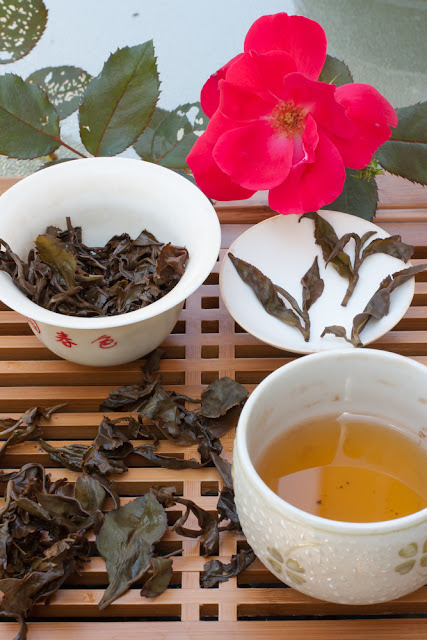
Tea From Vietnam - Gui Fei oolong - Also very high quality looking leaves - mostly "two leaf one bud" configuration


In addition to these four teas, Tea From Vietnam also has a couple more oolongs and a few green teas.  I did not order any green teas this time, but I have a fellow tea friend who did order some of the greens and found them quite enjoyable.  I look forward to trying those in my next order!  At the time of writing this, they provide free shipping on orders over $30, but orders under $30 ship for a flat rate of only $4.90, so these teas are very accessible to anyone in the world.  

Friday, September 18, 2015

A Perfect Day with Whispering Sunshine (2015) from Crimson Lotus Tea

I'm not too picky when it comes to describing nice weather.  I want comfortable temperatures, no storms, and comfortable levels of humidity.  I do get picky though when describing the weather on a perfect day, which includes temperatures in the low 70's or upper 60's, low humidity, a gentle breeze, and generally blue skies but with just enough clouds to keep it interesting and give some intermittent shade.   These are stereotypical spring or fall days in my opinion.  In Kentucky we truly do experience all four seasons, though I often wish spring and fall would last longer than they do; if we do happen to get a perfect day, then I want to make sure I fully enjoy it.

We recently had one of these perfect days, and the timing could not be any better because my Crimson Lotus Tea order has just arrived with their 2015 teas.  On this perfect day I knew exactly what tea I wanted to brew.  Though based on nothing more than a non-scientific gut feeling (since I had not tried any of these new teas yet), I knew that the perfect tea for this perfect day would be Whispering Sunshine.

Crimson Lotus sourced the material for Whispering Sunshine in person earlier this year and pressed it in China before returning home to Seattle.  They report that the leaves were harvested by hand in Bai Ying Shan (Lincang) and hand processed into mao cha by tea producers in the He Tao village.  Crimson Lotus chose the name for this tea because of Bai Ying Shan's high elevation which exceeds 2000 meters; so high that the "tea trees were close enough to hear the gentle voice of the Sun."

On this perfect day I found a long extension cord (despite discouragement from the kettle manufacturer) so I could set up a nice gongfu session outside on the patio.  The birch tree in the yard provided some cool shade yet the gentle breeze moved through the branches just enough to allow a few rays of warm sunshine to float down to the ground and dance across the tea table.  I couldn't think of a more perfect way to admire this tea.


The compression of this sheng puerh cake appears pretty light from the outside, but upon further picking it seems to be more dense than first though.  This may be a good balance of being loose enough to pick apart without doing too much damage yet tight enough to help lock in some of the fresh aroma, though after an initial rinse it still may be helpful to tease apart some of the tighter leaf clusters to help with more consistent brewing.


I have brewed this more than once by the time of editing this writing, and I found that using water around 200F/93C degrees results in almost no bitterness, though near boiling will give it a bite that some people prefer.  I also found that if you want low bitterness yet strong body, adding an extra gram or two of leaf than usual in addition to using 200F water works out great.

Whispering Sunshine brews up a yellow liquor that is slightly cloudy due to leaf fuzz, and if the light catches it just right it can give off a pleasant warm golden glow.  The mouthfeel is soft yet thick enough to coat the mouth with lots of flavor.

Although the initial taste has a hint of smoke from the wood-fire processing, the tea overall is extremely clean and fresh tasting.  The amount of leaf used will make a difference, but Whispering Sunshine has a very light and delicate flavor.  It has some vegetal characteristics, however not that of bitter leafy vegetables but that of green beans fresh from the garden and sweet peas.  This is beginning to sound like the flavor profile of a green tea, and the first thing I thought of when drinking Whispering Sunshine was that it reminds me of fresh Huang Shan Mao Feng green tea, with a floral aftertaste and honey sweetness similar to a high mountain oolong and a hui gan you would expect from a high quality puerh.  As the tea cools it reveals a subtle petroleum taste like that of a Riesling white wine, and at one point the freshness and cleanliness of this tea simply made me think of clean linens hanging on a line outside to dry in the afternoon sun.


There are some puerhs that are hard to judge (at least for me) when they are this young because they could be fairly bitter and strong and are hopefully going to improve after years of age, and then there are others which are extremely good right away and may be best consumed now rather than later.  To me, Whispering Sunshine has a perfect "drink me now" flavor, and I imagine that I will probably end up drinking through the entire 200g cake before having a chance to see how it will do over time.

Is this the perfect tea for a perfect day?  I believe the tea alone has the ideal flavor profile for a perfect spring or fall day, so yes, it must be, but all the additional information that Crimson Lotus has shared about this tea is really what solidifies the distinction.  If you have been following Crimson Lotus through their various social media accounts, you know that they gave weekly if not daily updates about their travels throughout China earlier this year.  I may never get a chance to visit Lincang, but I am very thankful that Crimson Lotus shared photos and stories while they stayed in places such as the the He Tao village.  The more we can learn about the tea that we drink, the better we can understand the cha qi held within its leaves.

When I sit on my patio and drink Whispering Sunshine on a perfect day I feel the calm Kentucky breeze on my face, but when I close my eyes I imagine myself standing on the steep northern slopes of the Bai Ying mountain.  The rustling leaves I hear may be my birch tree behind me or my maple trees that were planted about 20 years ago when my house was built, but maybe I'm hearing the leaves of ancient tea trees that have been growing in a remote forest long before I or anyone I know was alive.  Is cha qi simply the energy we get from caffeine and theanine, or is it the energy represented as experiences that ancient trees have accumulated over centuries of growth while watching the world change around them?  Perhaps a part of cha qi is simply an acknowledgement that energy has been transferred to us through the consumption of the tea; an energy that was transferred to the leaves themselves through chloroform, photosynthesis, and rays of whispering sunshine.


Link to Crimson Lotus Tea: http://crimsonlotustea.com
Link to Whispering Sunshine.

Sunday, September 6, 2015

What-Cha - Fujian Anxi 2008 Heavy Roasted Tie Guan Yin in Bitter Melon

(note:  This is a re-hosting of my review of this tea which I wrote in July 2015 on Reddit /r/tea)

I’ll be honest here. I bought this tea simply for the weirdness factor. OK, that may not be entirely true because I do really like roasted oolongs, but this is the first time I have seen anything like this, and when I first saw it on What-Cha, I immediately said, “I want that thing.” I even bought 100g of it because Alistair of What-Cha says, “We will endeavour to send out a whole bitter melon on orders of 100g or more.*” For some reason I felt that if I only ordered 50g I would only be getting half of the strangeness of this tea, and I didn’t want to feel cheated, and forget ordering just a 10g sample-- I imagine that would just be small handful of oolong balls and a few slivers of melon rind-- that’s hardly weird at all. I wanted to experience the full WTF (weird tea factor).

(*This was recently changed to, "All orders of 125g will be guaranteed to receive a whole bitter melon." as the 100g option has now been replaced with a 125g option.  I speculate that this is due to the many complex factors regarding the bitter melon market that I do not comprehend.)

So here it is. 100g (including the 5g in my gaiwan) of heavy roasted Tie Guan Yin stuffed into a Bitter Melon.

I can't stop staring into the intricate patterns and colors of the melon rind.  It's like an extraterrestrial landscape.

Although I did buy this because of how it looks, I was hopeful that my love for roasted oolongs would actually make this a useful purchase. It’s true, at first I was scared to even brew this tea; I have no idea what a bitter melon is, how it tastes, or if tea or anything else is routinely stored inside of one for practical reasons, but the tea itself looks like normal high roast TGY, though a bit squashed together, and it has a nice fruity smell like Fig Newton cookies, so that’s definitely a good sign!

Alistair said that it is recommended to break off some of the melon and brew it with the tea. For a moment I tried to pretend that I didn’t see that, but then I reminded myself that I want to experience this unique tea to the fullest so I made sure to toss a few melon chunks into my gaiwan. It’s much thinner and fragile than I imagined it would be; thin as an egg shell, but not quite that brittle, more like the bark of a sycamore tree.

The liquor looks like normal high roast TGY… nice light brown/orange color, and surprisingly very clear. A nice fruity smell with no unusual aromas... Maybe this isn’t scary after all...

I took a deep breath and then a sip. IT’S GOOD!

It has the flavors that I really like in a roasted TGY: cherry, charcoal, and hint a chocolate. This one is actually even better than the last roasted TGY I drank a week or two ago-- I’m also getting some raisin and tangerine flavors, and a very dominant flavor of figs. (The website mentioned plums… I haven't had any plums in a while-- Do figs and plums taste similar?)

Like a good oolong, this can be resteeped many times, and the fig flavor stays dominant throughout, with a nice fruity sweet fig aftertaste.

So my gamble of buying 100g of this tea definitely seems worth it-- not only did I get the entire full weird looking melon, but I also got 100g of tasty roasted oolong. And the price is actually very good. Although it’s weird, unique, and good tasting, it’s also very affordable-- the 100g package was less than $15.  I noticed that recently the 100g option has been replaced with a 125g option for just over $16, but you can also order this tea in 50g or 10g packages.  

This item to me is representative of why I really like shopping at What-cha. They seem to offer a wide variety of less common teas from a wide variety of sources, and the prices are very good. Even if I’m shopping for something somewhat normal, I try to look around their selection for at least one unique item to throw in my cart just because it’s not an opportunity you have everywhere. Don't be afraid to try something weird!

Saturday, August 29, 2015

White2Tea Tea Club - August 2015 (Da Hong Pao oolong)

I am one of the newest members of the White2Tea monthly tea club.  My first month was July which I'll likely post about later, but today I had two of the three teas featured in the August package which highlighted some Wuyi oolongs.

Although White2Tea's primary focus is in puerh, they do have some select Chinese black teas and oolongs.  The tea club package for August hints that they are in the process of adding new oolongs to the selection, one of which will be an aged Da Hong Pao.

To give some perspective on what some age can do to a Dahongpao, the package included a sample of freshly roasted Dahongpao for comparison to the aged DHP.  So it made sense for me to drink them on the same day.


These teas are reportedly made by the same farmer on the same land, but the aged one is about 8 years old.  At first glance there are not too many visual differences, though the aged one may be slightly more brown.  The aroma though does reveal more roast scent in the fresh version where as the aged one has a bit of leather smell instead.  Both teas have a dominant chocolate smell in the dry leaf.

Both teas brew a nice clear reddish brown liquor with similar looking wet leaves, but the similarities stop there.  The brewed fresh DHP smells of fresh cherries and strawberries and is very candy-like.  The gaiwan lid actually smells exactly like cotton candy.  The brewed aged DHP has a darker aroma of black cherries and raisin with a hint of fig.

The mouthfeel of the fresh DHP is very thick but otherwise not very active, while the aged DHP has a very soft body and a mouthfeel that is active with pleasant astringency and tartness on the back and sides of the tongue.


The enclosed description newsletter with this month's teas mentioned that the fresh DPH will have "thrashing youth" and "harsh and sharp" roast flavor compared to the aged one which should be "mellow" because the "fire flavors have subsided."  After tasting these teas I can easily agree that the aged DHP is much more mellow than the fresh.

The fresh version is initially very sweet and fruity, though almost unnaturally so-- like strawberry candy as opposed to real strawberries.  The roast flavor does seem harsh and almost gives the tea a plastic taste, but the fruit flavors keep it enjoyable.  The aged one still has a dominant presence of fruit in the initial brew, but the fruits seem more natural and darker, like black plums, black cherry, and autumn apples.  The aged DHP is definitely very mellow compared to the Fresh and has a hint of that "dry leather" taste that I find in some aged teas.  With the roast flavor being less prominent, the aged tea takes on an obvious mineral/earthy clay flavor under the fruit notes.

The aftertaste of both teas is pleasant and  follows the main taste.  The fresh DHP has a lingering strawberry jam aftertaste and the aged one has a nice apple cider aftertaste with an apple peel flavor in the back of the throat-- I'm not sure what it is about apple peel aftertastes, but all my favorite roasted oolongs have this.  Both teas have a floral component to the aftertaste which begins to show up after a few infusions.

As the teas evolve over further infusions the aged one seems to remind me more and more of a slightly aged sheng puerh as some orange peel and coriander flavors start to come through.  Much to my surprise the fresh one began to transform with very strong and dominating presence of guava!  It still remained candy-like though, and had nearly an identical taste as a guava candy that I am very familiar with.  My favorite Chinese restaurant has a large bowl of them on the checkout counter, and I used to sneak extras into my takeout bag until very recently when I found out that I can buy them in bulk at my local Asian supermarket.  These would be a great way to extend the aftertaste of this tea if you wish.


Overall it is almost difficult for me to say which of these teas I liked better.  As of right now the Fresh Dahongpao is not a tea that White2Tea is planning to have for sale (at least in its young state) and was simply included as a comparison tea for the aged version.  The club newsletter actually mentioned that it would "likely not be a crowd favorite, though some may love it."  I do agree that the "freshness" of this recently roasted tea does come across as "harsh" and "sharp" and the flavors seem almost unnatural, but the flavors are definitely interesting and the tea seems a bit unlike other teas I have had which makes it something I would enjoy drinking from time to time.  I drank it today on a mild summer day which was nice, where as the aged DHP would be cozy on a cool autumn day.  The apple peel taste of the aged tea is a key flavor I love in roasted oolongs and easily makes this one I would consider buying more of.  As of right now I do not know the price since the website has not been updated yet and that would be an important deciding factor.  I also think that the aged one would do better with even more leaf.  I had my gaiwan about 1/3 full but would definitely like to try this tea again with at least 1/2 full.

The third Wuyi tea included in this month's package is called "Clover Patch Oolong," which is reportedly very different from the DHP despite coming from the same farmer.  I will brew that one soon!

Keep an eye on the White2Tea oolong page where we'll hopefully see some new teas added soon.  I still need to try more of the ones that are already there as I've only had the OBSX so far, and it's REALLY good.